
On a construction site, the biggest problems often come from what you cannot see. Gas pipes, telecom ducts, power cables, and water lines run unseen beneath sites across the UAE, Saudi Arabia, and Qatar. Locating them before you dig, with an underground utility survey, saves time, money, and a great deal of risk. It is one of the cheapest steps on a project and one of the most overlooked.
In this article
What an underground utility survey is
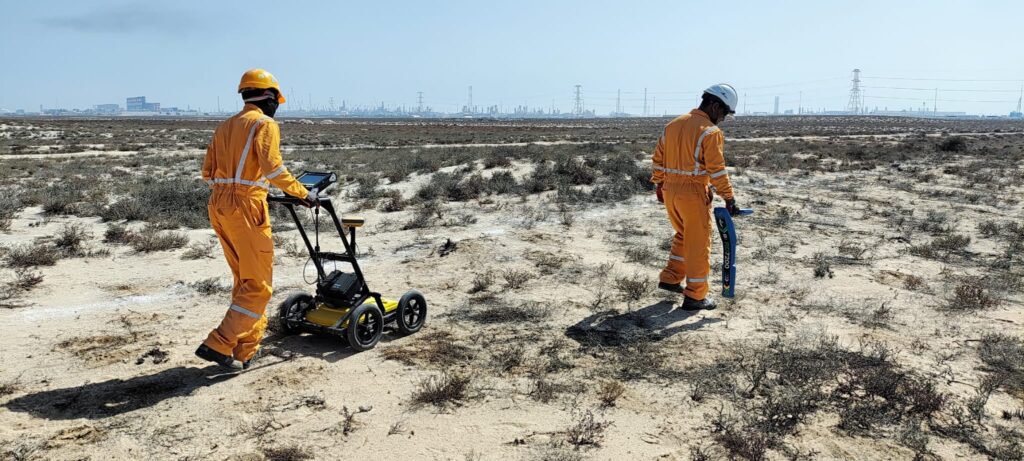
An underground utility survey is a safe, non-destructive way to locate and map buried services. Using modern methods such as electromagnetic utility locators and GPR scanning, surveyors work out what lies below without excavating or disturbing the site. The result is a clear map of the pipes, cables, and ducts under your feet, produced before anyone breaks ground.
Why it matters before you dig
Knowing exactly where underground services sit lets a project team plan more safely and work more efficiently. A struck cable or pipe is never just the cost of the repair. It is the stopped work, the safety incident, the utility authority involvement, and the schedule slip that follows. Finding those services on a drawing first removes most of that risk at a fraction of the cost.
An underground utility survey is not just a precaution. It is the smartest first step on the site.
The benefits for your project
A good survey before excavation helps you:
- Avoid unexpected damage to live services.
- Cut costly delays and rework.
- Improve safety for workers and equipment.
- Plan foundations and excavation around what is actually there.
Each of those shows up directly in the programme and the budget, which is why subsurface surveys are increasingly a standard requirement before excavation in fast-growing cities across the GCC.
Where these surveys are used
Underground utility surveys are used widely across the region for building construction and site preparation, road and infrastructure projects, utility upgrades and maintenance, and redevelopment or remodelling work. Anywhere a dig is planned on ground that has been built on or serviced before, a survey is worth doing first.
The technology behind clear results
Modern surveys combine GPR, electromagnetic location, and digital mapping with experienced analysis to produce dependable, unambiguous results. GPR finds both metallic and non-metallic services, while electromagnetic location traces and confirms metallic lines, and the two together are far more reliable than either alone. The output is a clear plan that engineers, contractors, and planners can act on with confidence from day one. Our underground utility survey services are built around delivering exactly that. Knowing what is beneath your site protects the project, the people on it, and the investment behind it.