


Large-scale projects, smart cities, and infrastructure are expanding quickly throughout the Gulf area, which includes Qatar, Saudi Arabia, and the United Arab Emirates. Digital mapping and contemporary surveying technologies have emerged as crucial instruments for precise planning, secure construction, and effective project execution in order to facilitate this growth.
These days, cutting-edge technologies like GIS mapping, LiDAR, and drone surveying are changing how surveying is done throughout the Gulf Cooperation Council.
Explain Digital Mapping.
The process of gathering, evaluating, and presenting spatial data utilising cutting-edge technologies is known as digital mapping. In contrast to conventional surveying techniques, digital mapping offers precise visualisation of land and structures, quicker data collecting, and high-accuracy results.
In the GCC, digital mapping services are frequently utilised for:
Developing cities
Planning of infrastructure
Managing land
Building and engineering initiatives
The GCC’s Drone Surveying
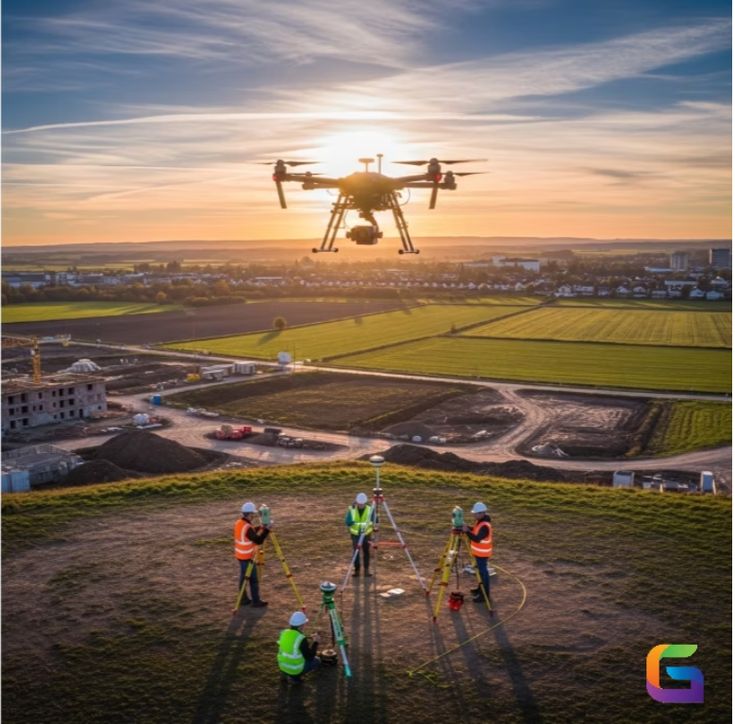
In the GCC, drone surveying has emerged as one of the most effective contemporary survey techniques. Surveyors can quickly obtain high-resolution aerial data and photographs by using unmanned aerial vehicles (UAVs).
The main advantages of drone surveying:
Quick data gathering for big areas
Superior precision and intricate visuals
Safe surveying in challenging or limited areas
economical when compared to conventional techniques
In the GCC, drone surveying is frequently employed for:
Topographic analyses
Monitoring of construction progress
Road and infrastructure initiatives
Planning of land development
LiDAR Technology for Surveys with High Accuracy
A potent surveying tool called LiDAR (Light Detection and Ranging) uses laser pulses to detect distances and produce accurate three-dimensional representations of buildings and terrain.
LiDAR surveys are crucial in the UAE, Saudi Arabia, and Qatar for:
Mapping complex terrain
Utility and infrastructure projects
Development of smart cities and urban planning
Precise mapping of contours and elevation
LiDAR technology is perfect for large-scale GCC projects because it provides high-density data even in difficult conditions.
GIS Mapping and Analysis of Geographical Data
In order to manage and analyse survey data, Geographic Information Systems (GIS) are essential. Engineers and planners can combine several data layers, such as land features, utilities, and environmental data, through GIS mapping.
The GCC uses GIS for:
Planning and asset management for infrastructure
Analysis and mapping of utilities
Developing smart cities
Making choices and evaluating risks
For projects in the public and business sectors, GIS aids in converting unprocessed survey data into understandable, useful information.
The Significance of Contemporary Surveying Technologies in the GCC
Accurate and trustworthy surveying solutions are necessary due to the GCC’s severe environment, large land areas, and fast expansion. LiDAR, GIS, and drone surveying are examples of contemporary technologies that guarantee:
Lower project risks
Increased precision in planning
Quicker project schedules
Improved adherence to rules
Expert digital mapping services promote long-term infrastructure success and sustainable growth.
Selecting an Effective Digital Mapping Partner
Choosing a seasoned surveying firm is essential to getting trustworthy data. A qualified supplier with up-to-date tools and local knowledge guarantees:
Precise data gathering
adherence to GCC regulations
Effective project completion
In conclusion
The future of infrastructure and building in Qatar, Saudi Arabia, and the United Arab Emirates is being shaped by digital mapping and contemporary surveying technologies. Projects can be planned and carried out more precisely, safely, and effectively with the use of tools like drone surveying, LiDAR, and GIS.
Investing in cutting-edge digital mapping services is now essential as the GCC grows.